Who’s behind this article?
You’re reading Sensuali.
A space for exploring intimacy, sensuality and kink. Message trusted practitioners, book real experiences, discover sensual events and get answers in our forums.
No fees to browse · 18+
Fetish art has given birth to some of the most iconic and provocative illustrations in the world of contemporary art. Pioneering fetish illustrators have not only showcased the depth and range of human fantasies but have also challenged societal norms, inspiring acceptance and understanding of various kinks and fetishes, and helping us reach where we are today in our gradually progressing sex-positive society.
The evolution of kink illustration
Kink illustration, a mesmerising blend of art and desire, offers glimpses into the unspoken corners of human fantasies. Tracing its history from early depictions to modern digital art forms, we delve into the legends that have shaped the world of kink illustration.
The origins of fetish art
While erotic art has ancient origins, the 20th century heralded a refined focus on kink illustration. Figures like John Willie took centre stage, laying foundational stones with works such as Bizarre magazine.

The pioneers of fetish art and their vision
Artists like Eric Stanton brought kink illustration to a broader audience with femdom-centric comics. Collaborations with mainstream figures like Steve Ditko further popularised it. Tom of Finland, on the other hand, broke barriers with his homoerotic takes.


Evolving themes in kink illustration
As societal attitudes shifted, so did the themes of kink illustration. The likes of Betty Page redefined what was considered risqué, while Robert Bishop and Gene Bilbrew pushed the boundaries even further.
Book erotic art experiences on Sensuali
Erotic art (drawing, painting, or a sculpture) based on your picture
Artist's Model & Erotic Muse ~ Kinky Figure Drawing (Virtual or In-Person)
Portland, US
Erotic Art Lessons
Personalized & Custom Painting
Custom Erotic Audio, Writing, & Original Art for Sale
The timeline of famed kink illustrators
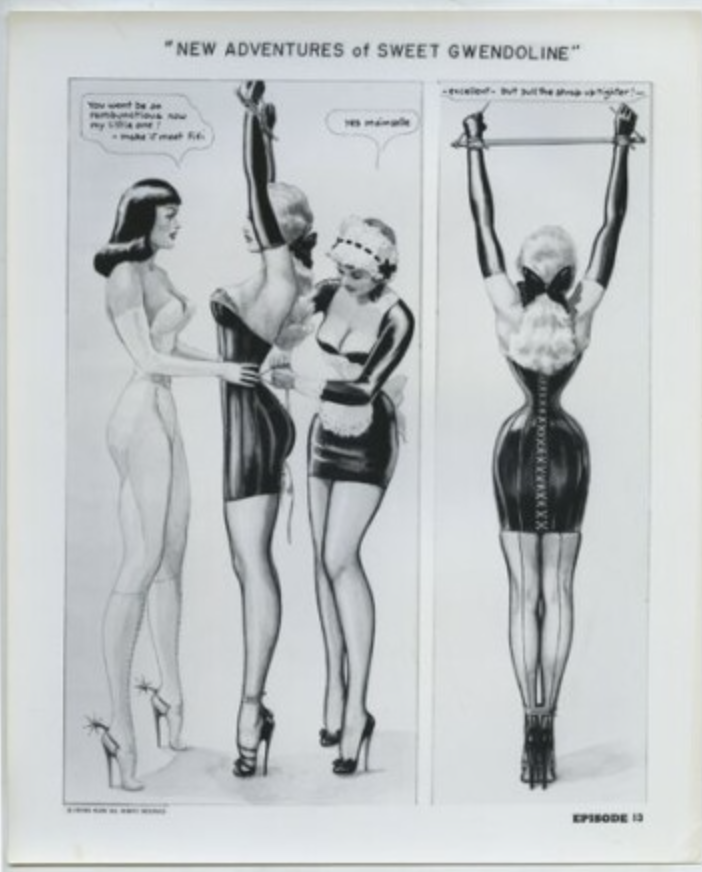
John Willie (1902-1962): Known for his iconic character “Sweet Gwendoline” and his work in the bondage and fetish art realm, John Willie’s illustrations are considered classics in the fetish art world.

Eric Stanton (1926-1999): Stanton’s artwork often depicted strong, dominant women engaging in various fetish scenarios. His style has had a lasting influence on the world of fetish illustration.
Tom of Finland (Touko Laaksonen, 1920-1991): Tom of Finland is celebrated for his homoerotic fetish art that prominently features muscular, hypermasculine men in leather and other fetish gear. His work played a pivotal role in shaping the aesthetics of gay culture.
Namio Harukawa (1947-2017): Namio Harukawa’s artwork explored themes of facesitting and female domination, often featuring dominant women and submissive men. His unique style and bold compositions gained him a dedicated following.
Hajime Sorayama (b. 1947): While not exclusively a fetish artist, Sorayama’s blend of eroticism and technology has captured attention. His highly detailed and realistic portrayals of human-like robots often touch upon themes of fetish and desire.
Olivia De Berardinis (b. 1948): De Berardinis is renowned for her pin-up and fetish art featuring confident, glamorous women in various fetishistic scenarios. Her work has appeared in magazines, galleries, and on album covers.
Sardax: A contemporary fetish artist, Sardax is known for his intricate digital illustrations that explore themes of domination, submission, and BDSM. His work often captures the dynamics of power and vulnerability.
Gene Bilbrew (1923-1974): Working under various pseudonyms, Gene Bilbrew created a vast body of fetish illustrations, particularly in the realm of bondage and domination. His work was influential in shaping the visual language of fetish art.
Rubex: This contemporary artist specializes in latex fetish illustrations. Their colorful and vibrant depictions often celebrate the sensuality of latex clothing and the unique visual appeal it brings to the fetish world.
Jim of Holland: Known for his imaginative and whimsical fetish art, Jim of Holland creates playful and erotic illustrations that explore various kinks and scenarios.
These illustrators have left a lasting impact on the world of fetish art, each contributing their own unique style and perspective to this diverse and intriguing genre.
Kink illustration: more than just art
Beyond visual allure, kink illustration became a powerful tool for activism and cultural shift. Artists like Annie Sprinkle and Midori merged their work directly with advocacy, using their illustrations to champion LGBTQ+ rights and dismantle myths surrounding kink and sexuality.
Their work didn’t just depict fantasy, it legitimised desire as worthy of artistic and intellectual exploration. By centering marginalised bodies and desires in their art, these illustrators challenged the gatekeeping of who gets to be celebrated as beautiful or desirable.
This activist impulse remains central to contemporary kink illustration, where visibility itself functions as a political statement. Many artists today see their work as a form of education, normalising conversations around consent, pleasure, and the full spectrum of human sexuality in spaces where these discussions have historically been silenced.
The digital revolution of kink illustration
Digital platforms fundamentally transformed kink illustration’s reach and accessibility. Artists like DollDivine and Oliver Rath leveraged the internet to bypass traditional gallery systems and publishing gatekeepers, building direct audiences and communities around their work. Social media and artist platforms democratised creation. Suddenly, illustrators didn’t need industry approval to reach thousands.
This shift also changed the medium itself. Digital tools allowed for faster iteration, blending of styles, and the emergence of new aesthetics that pushed beyond what was possible with traditional media.
The democratisation of digital tools meant more diverse artists could enter the space, bringing fresh perspectives and aesthetic languages to kink illustration.
Communities formed around shared interests, allowing viewers to discover work aligned with their specific desires and creating feedback loops that pushed artists to experiment further.
The societal impact of kink illustration
The influence of kink illustration has quietly permeated mainstream culture far beyond niche circles. Elements drawn from Bilbrew and Bishop – latex aesthetics, power dynamics, bold linework, exaggerated forms – now appear in high fashion, music videos, and advertising.
Pop icons like Rihanna and Lady Gaga have directly incorporated kink illustration aesthetics into their visual identities, signalling a broader cultural acceptance of these once-taboo visual languages. This mainstreaming matters because it shifts what’s considered acceptable to look at, to desire, to wear.
Fashion designers reference fetish wear without irony. Mainstream films and television shows employ kink illustration’s visual vocabulary. What began as underground art has become a template for how contemporary culture visualises power, sexuality, and self-expression.
This visibility has concrete effects: it normalises conversations about desire, makes certain bodies and fantasies feel less shameful, and gives people permission to explore their own aesthetics without fear.
The future of kink illustration
As technology evolves, kink illustration continues to expand into new territories. Artists like Hajime Sorayama have already begun merging artificial intelligence, hyperrealism, and fetish aesthetics, creating unsettling and compelling work that asks questions about desire in a technological age.
The intersection of virtual reality and kink illustration presents intriguing possibilities. Think immersive, interactive experiences that could shift the medium from passive viewing to embodied exploration. Meanwhile, emerging platforms like NFTs and metaverse spaces are creating new economies and communities around kink art.
Younger artists are pushing into animation, interactive media, and gaming, territories where fetish aesthetics and narratives can unfold dynamically.
As sex-positivity continues to gain ground culturally, kink illustration will likely become increasingly intertwined with mainstream artistic practice.
The future suggests not a mainstreaming that waters down the radical potential of kink art, but rather a proliferation of spaces where desire, in all its specificity and variation, gets to exist openly and celebrated.
Connect with erotic artists around the world
On SensualiArmandoCabba
Paris
MRain
Bangkok · Singapore
Nathalie
San Antonio · Austin
LuckyLikesLicks
Vancouver
bodycastingy_you
Camporgiano · Lucca · Forte dei Marmi
Somanatrix
Austin
nudesbybeth
Auckland
ArtCologne
Cologne
samuelmccrackenart
Ayame
New York · Highland Park
Vanillacooldance
Amsterdam · New York
MechaPencilGirl
Philadelphia
askandy
Berlin
nudesbybeth
Auckland
LuckyLikesLicks
Vancouver
Hikari
Lisbon
FunSizeFemdom
Denver
Jimmy
Berlin
pinkneonsky
Loveland
LuckyLikesLicks
Vancouver
kemoburns
Los Angeles
mervyn
Valencia
SilentTeddyBear
Budapest
Are you a Kink illustrator? Join the party on Sensuali today.
More on fetish culture and its history: what is a smoking fetish? femdom and female power through history, zentai and fetish wear for sensual adventures, the smoking fetish explained and the facesitting fetish explained.
On kink: consensual non-consent — harmless kink or recipe for disaster?
Read more: London’s most progressive strip clubs.
Related reading: vicarphilia — the quiet thrill of living through others.