Most of us live from the neck up. We think our way through the day, manage our bodies like projects that need fixing, and spend less and less time actually present in them. So it makes sense that in sex, too, we can easily become detached, and end up feeling a need to perform, however subtle that pushing feeling is. For a growing number of women, tantra offers a way back from that.
Unlike therapy, tantra doesn’t start with talking. It heals the body by working with the body: breath, sensation and touch, practised rather than discussed.
Here’s everything you need to know about tantra, and how to start exploring it as a path back to your body.
What is tantra?
The first thing to understand is that tantra is not a technique. It’s a philosophy, a concept, a way of living, and practising tantra simply means practising that way of living. The breathwork, the massage, the rituals: those are expressions of it, not the thing itself.
So what is the philosophy? Tantra emerged in India around the 6th century CE, weaving its way through both Hinduism and Buddhism over the centuries that followed.
The word itself comes from the Sanskrit root tan, meaning to weave or expand, and that’s a good clue to the idea at its heart: nothing is separate. Body and spirit, pleasure and consciousness, the everyday and the sacred are all threads of the same fabric.
That was radical at the time. Most spiritual traditions taught that the body and its desires were distractions to overcome. Tantra said the opposite: everything is divine, including the body, including pleasure.
You might think we’ve moved on a lot since then. But isn’t sex still treated as something to be put in one corner, something almost embarrassing, and for women, often shameful? In that sense we still have plenty to learn from tantra.
For women trying to unlearn the narratives that taught us to close off our bodies, live in our minds, and struggle to access pleasure through shame or fear, tantra’s core idea is as useful now as it ever was: the body isn’t the obstacle. It’s the doorway.
So at its simplest, tantra is the practice of being connected: to the moment, to your body, to whatever you’re experiencing. And that’s exactly why it speaks to intimacy. Because intimacy is presence. You can’t feel pleasure you’re not present for, and you can’t connect with someone else while you’re absent from yourself. Tantra trains the one thing intimacy actually requires.
Read our full guide to tantric philosophy.
Why is tantra helpful for women disconnected from their bodies?
Because for most women, that disconnection was learned, and what was learned can be unlearned.
From early on, women learn to experience their bodies from the outside.
You learn how your body looks before you learn how it feels. You learn that pleasure is something you give or perform, rather than something that belongs to you.
Researchers call the result spectatoring: watching yourself during intimacy instead of being inside it, while sensation fades into the background.
Add shame, conditioning, difficult experiences, or simply years of rushing, and the body learns to go quiet. Many women describe feeling numb, in body or in bed, not because anything is medically wrong, but because attention and sensation have been trained apart.
Tantra works directly on this. By slowing everything down and removing the goal, it gives you a different experience: being in a body that is felt rather than watched, touched without an agenda, present without performing.
In fact, one of the biggest aims of a tantric approach to intimacy today is decentring any type of goal, along with all the pressure and performance that comes with one.
Instead, you learn to experience touch purely for the sake of touch. Nothing to reach or prove, nothing else that matters except allowing yourself to experience sensation as it happens. And within that, the art of giving and receiving: learning what it is to touch with full attention, and to receive without owing anything back.
Who is tantra suited to?
Tantra isn’t only for the spiritually inclined or the already-confident. In practice, it tends to call to women who recognise themselves in one or more of these:
- Women who feel disconnected from their bodies. You function fine, but you live in your head. Your body is something you maintain rather than inhabit.
- Women whose pleasure has gone quiet. Low desire, difficulty feeling much during sex, or a sense that intimacy has become routine or performative.
- Women carrying old experiences in the body. Where talking has helped you understand but not helped you feel safe or open, a body-based approach can reach what words can’t.
- Women in transition. After a breakup, after birth, through perimenopause, or in any season where your relationship with your body is being renegotiated.
- Women who are simply curious. You don’t need a problem to solve. Wanting more depth, more sensation and more intimacy with yourself is reason enough.
If any of these land, tantra is likely to have something for you.
How do women explore tantra today?
There’s no single way in. Tantra can be a private daily practice, a guided one-to-one experience, or something you explore in community. Most women end up combining a few of these over time.
Solo practice. The foundation. Conscious breathing that drops attention out of the head and into the belly and pelvis. Slow self-touch with no goal, where the point is to feel rather than to finish. Movement and sound that let the body express instead of contain. Even ten minutes of this changes something, because attention is like a muscle: the more often you bring it into the body, the more naturally it lives there.
Tantric coaching. One-to-one sessions with a tantra coach or educator, usually combining conversation, guided breathwork and embodiment exercises, sometimes with homework between sessions. Coaching suits women who want structure and a guide who can help introduce them to tantra as a philosophy and explore everyday practices which will help them over time.
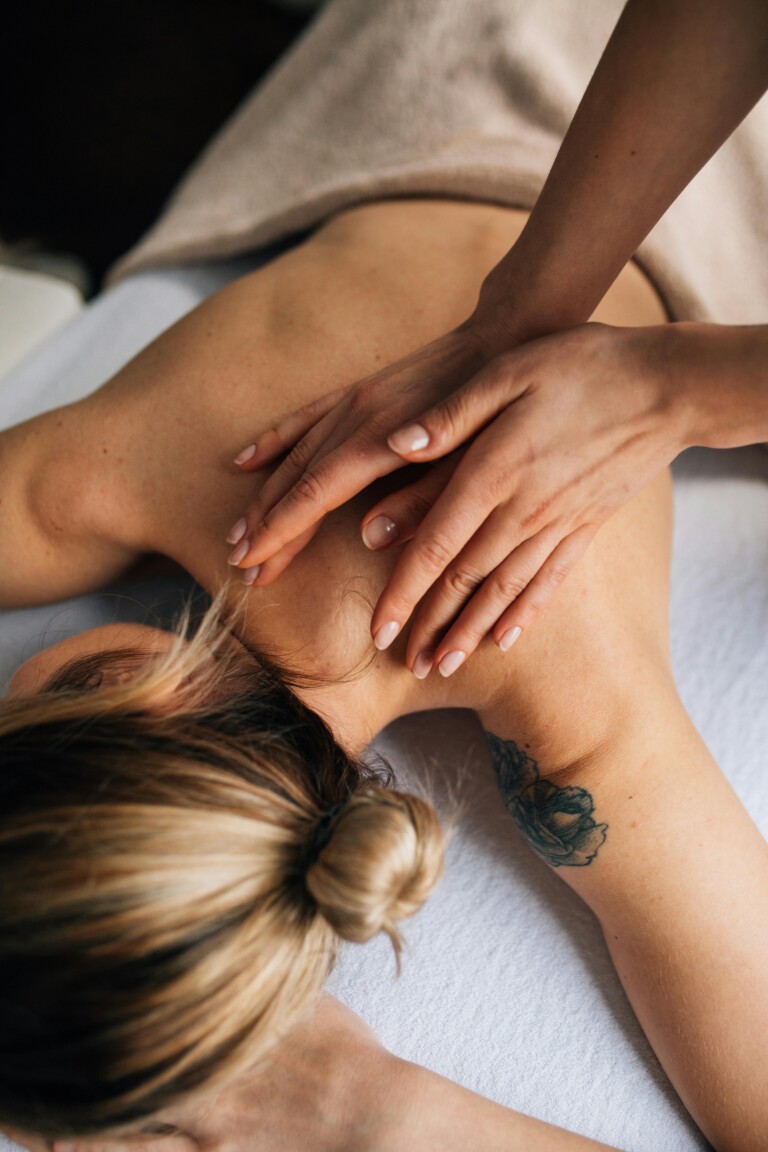
Tantric massage. A massage might sound like an odd place to start healing your relationship with your body, but remember where the disconnection lives. You can’t think your way back into feeling. At some point your body needs the actual experience of being touched safely, with full presence and nothing expected back, and for most women that experience is rare. That’s what a tantric massage provides, and the body remembers it: touch can feel safe, receiving is allowed. That’s what carries into intimacy long after the session. Our guide to tantric massage for women covers what to expect.
Day workshops. A low-commitment way to taste group tantric practice. A few hours of guided breathwork, movement, eye-gazing or sharing circles, guided by a certified practitioner. Practising alongside other women normalises what can otherwise feel private and strange, and many women find the group setting unexpectedly moving.
Tantric retreats. Long-form immersion, often several days, frequently women-only. Retreats give the nervous system time to genuinely soften, which is hard to achieve in a single session squeezed between work and life. They tend to suit women ready to go deeper, or marking a significant transition.
As a couple. Tantra is also a path you can walk with a partner. Couples sessions, workshops and retreats teach you to slow down together, communicate desire honestly and break the scripts that long-term intimacy falls into. For many couples it’s less about new techniques and more about meeting each other freshly.
Where to begin exploring tantra
You don’t need to be flexible, spiritual, sexually confident or healed to begin. All tantra is, at its core, is learning to be present. It ties in with yoga in that sense: it’s breath, it’s presence, that’s all it is. That’s worth remembering before you explore anything.
Start small. One workshop, just to see. And when you’re ready for guided experience, choose your practitioner with care: someone whose language, boundaries and approach feel right to you, because in body-based work, trust is the practice.
We created Sensuali as people passionate about alternative intimate wellness practices, often body-based ones, and we verify every practitioner on the platform ourselves.
On Sensuali you can discover trusted tantric practitioners and reach out to book a session, or start with a consultation call to learn more.
Explore online & in-person tantric coaching, massage and workshops on Sensuali.
Discover more sensual wellness experiences for women.
Related reading: Tantric massage for women: what to expect and why it’s different, Somatic tantra for healing: working with trauma and the body or Book a tantric session for women on Sensuali.