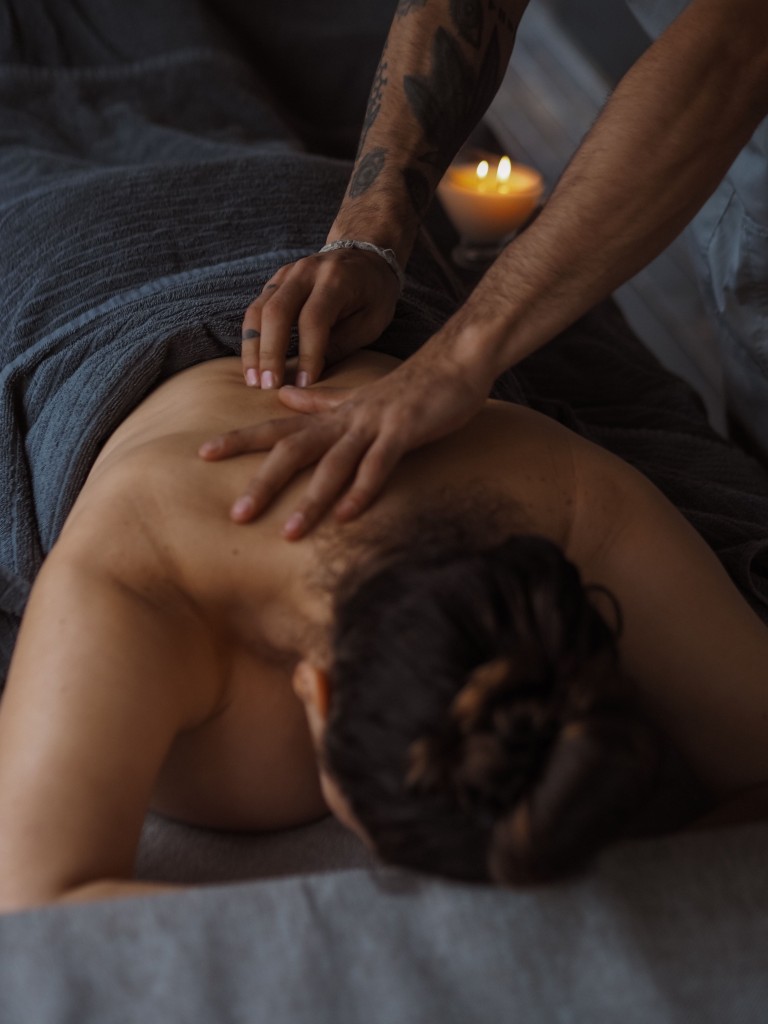
What you'll know after reading this
- Presence can transform pleasure. Mindfulness and bodily attention may improve sexual arousal, function and our ability to actually notice sensations.
- Tantric practices may support wellbeing. Research into meditation, breathing and yoga suggests benefits for stress regulation, while mindfulness-based approaches show promising results for sexual wellbeing.
- The science is promising, but not definitive. Direct research on Tantra is still limited, so claims about its benefits should be made with curiosity rather than certainty.

Tantra is far more than sexuality. At its heart, it invites us to slow down, breathe and become more present in our bodies. While research specifically on Tantra remains limited, studies on mindfulness, meditation, yoga and conscious sexuality suggest potential benefits for stress, body awareness, sexual desire and wellbeing supporting what tantric practitioners have explored experientially for centuries.
Tantra is one of those words that seems to promise quite a lot and to also be over-used and sometimes a little confusing.
Before looking at the benefits of Tantra, there is a little confusion to clear up. Tantra isn’t actually synonymous with tantric sex although you could easily believe that from spending five minutes on the internet.
What do we actually mean by Tantra?
Tantra refers to a diverse collection of spiritual traditions that developed in India within Hinduism and Buddhism. Historically, tantric practice included meditation, mantra, visualization, ritual, yoga and practices involving the subtle body and energy. Sexuality existed within some tantric traditions, but it was never the whole story.
What we commonly call tantric practices today, particularly in the West, is somewhat different. Contemporary or “neo-Tantric” practices often combine meditation, conscious breathing, movement, touch, body awareness, ritual and sexuality. They tend to share one central idea that I find particularly interesting: instead of rushing towards an outcome, we bring our attention back to what is happening in the body, right now.
Basically it is awareness, slowness and attention to all the signals that we feel in our bodies in combination with our breath.
I love exploring tantric practices, but I am also increasingly interested in the gap between what we feel through these experiences and what we can actually demonstrate. Working around sexuality and intimacy, I hear beautiful stories all the time about people reconnecting with their bodies, discovering sensations they had forgotten, or experiencing a completely different quality of presence with another person.
But when we talk about the benefits of Tantra, what does research actually say?
Scientists generally aren’t putting 100 people into a laboratory and asking half of them to attend tantric workshops for six months. Instead, research tends to investigate its components individually: mindfulness, meditation, breathing, yoga, body awareness and mindful approaches to sexuality.
I went digging into the studies and some of the findings are quite juicy.
Benefit #1: Tantra may help us get out of our heads and into our bodies
Perhaps the most convincing research relates to something incredibly simple: attention.
One thing Tantra has repeatedly taught me is how astonishingly difficult it can be to actually be where your body is.
You can be touched and simultaneously think about tomorrow’s meeting. You can have sex while wondering what your stomach looks like. You can receive a massage while mentally writing an email.
Our bodies are having an experience while our minds are somewhere else entirely.
Sex researcher and psychologist Lori Brotto has spent years investigating mindfulness and sexuality. She describes mindfulness as the practice of paying attention to the present moment intentionally and without judgment, and points out that distraction, performance anxiety, negative expectations and fear can all interfere with sexual response.
In Better Sex Through Mindfulness, she puts it wonderfully simply:
Attention is a key factor in sexual arousal.
And this seems to be supported experimentally.
A laboratory study involving 41 women found that a short mindfulness exercise focused on bodily sensations increased subjective sexual arousal and increased the correspondence between what participants physically experienced and what they consciously perceived.
That finding fascinates me because it describes something I have personally experienced through tantric and embodied practices: sometimes pleasure isn’t necessarily missing. We simply aren’t fully present in our bodies to be able to delve deep into it.
Benefit #2: Mindfulness seems to improve sexual wellbeing
A 2017 meta-analysis examined 11 trials involving 449 participants receiving mindfulness-based therapies for female sexual dysfunction. Overall, sexual function and subjective sexual wellbeing improved, generally with moderate effect sizes, although the researchers also highlighted limitations in the quality of the available evidence.
More recently, a meta-analysis of 11 studies found that mindfulness-based cognitive therapies improved women’s sexual function and reduced sexual distress. The researchers did note substantial variation between the studies, so the findings shouldn’t be treated as definitive proof.
One particularly interesting clinical study followed women experiencing low sexual desire and arousal. After four 90-minute sessions incorporating mindfulness meditation, cognitive therapy and sexual education, participants reported improvements in desire, arousal, lubrication, satisfaction and overall sexual functioning. Another randomized controlled trial involving 70 women found improvements in sexual desire, sexual distress, sexual self-disclosure and sexual function following mindfulness-based cognitive behavioural sex therapy.
Of course, mindfulness is not exactly Tantra. But if you’ve ever attended a tantric session and been invited to slow down, breathe, observe sensations without immediately acting on them and return your attention to your body, the overlap is rather obvious.
Benefit #3: Tantra could change our relationship with desire
Many of us approach desire as something we have or not: being horny, having a high libido or losing our libido. Sexuality becomes then conditioned to the level of our desire for someone.
Tantric practices have given me a slightly different relationship with this. Desire can also be something we create the conditions to notice.
And research around mindfulness seems to support this possibility.
In one study of 1,718 women, greater dispositional mindfulness was associated with better sexual function, less sexual distress and lower odds of experiencing female sexual dysfunction, even after researchers adjusted for several potential confounding factors.
A 2023 intervention study provides another interesting clue. After four weeks of mindfulness practice, women experiencing psychogenic sexual dysfunction reported improvements in desire, arousal, lubrication and orgasm, alongside improved sex-related quality of life. The authors themselves stressed that the study lacked randomisation and an adequate control group, so more rigorous research is needed.
Sexuality is not a vending machine where we insert ten minutes of meditation and receive an orgasm. But attention appears to matter over time.
Benefit #4: Tantric practices may help with stress
This is another area where the evidence becomes intriguing.
There has even been a small study specifically examining tantric yoga.
Twenty-two participants practised tantric yoga twice weekly for six weeks. Researchers measured both perceived stress and salivary cortisol. Cortisol dropped by approximately 24% immediately after both the first and final sessions, while reported irritability, tension, fatigue, fear and anxiety also decreased over the six-week period.
Now, 22 people is a tiny sample, and there was no control group. This is absolutely not evidence that Tantra magically regulates your hormones.
But the broader research on yoga, meditation and breathing is considerably larger.
A systematic review of 28 studies involving 2,574 people found that most studies examining a single session of meditation, breathing or yoga reported reduced physiological or psychological stress reactivity.
A separate systematic review and meta-analysis of yoga for stressed adults found evidence for reductions in perceived stress, although the researchers rated much of the evidence as low quality and emphasized methodological limitations.
So perhaps one of the benefits of Tantra is not that it adds something mysterious to us, but that it creates conditions in which the nervous system can occasionally stop doing quite so much. And personally, that may be one of the effects I value most.
Benefit #5: Presence may change intimacy itself
There is also something harder to quantify. What happens when two people actually pay attention to one another?
Letting go of performance pressure, anticipation for the next move or of the need to orgasm. They just focus on being there, present with each other, listening to our own body and to the body of our partner.
A 2025 study followed 141 couples for 28 days and found that people with higher levels of sexual mindfulness at baseline reported better sexual functioning in their daily lives. Interestingly, the effect was primarily individual: one person’s mindfulness predicted their own sexual function, but not their partner’s.
That distinction matters. Tantra isn’t evidence that two people will suddenly become perfectly connected. Presence cannot guarantee chemistry, compatibility or intimacy.
But it may change how available we are to experience them.
As sex therapist David Schnarch wrote:
What is most human about human sexuality is our unique capacity for intimacy.
I find that a beautiful way of thinking about tantric practice. The goal is not performing better sex but being more capable of inhabiting ourselves while meeting somebody else.
So, are the benefits of Tantra scientifically proven?
Not exactly and it’s important to be careful about pretending otherwise.
Research specifically investigating Tantra remains limited. Much of what we currently know comes from studies of mindfulness, yoga, meditation and mindfulness-based sex therapy. The research is also disproportionately focused on women experiencing sexual difficulties, meaning we know considerably less about men, queer and trans populations, non-monogamous relationships and people simply exploring sexuality rather than treating a dysfunction.
Most studies are done with small groups and “Tantra” itself can describe wildly different practices.
Still, taken together, the evidence suggests something worth paying attention to.
Practices commonly found in contemporary Tantra are associated with lower stress, greater bodily awareness, improvements in sexual desire and function, reduced sexual distress and a greater capacity to remain present during intimacy.
Perhaps science is beginning to put measurements around something tantric practitioners have explored experientially for a very long time:
Pleasure requires attention, intimacy requires presence and slowing down allows us to feel considerably more. The more you explore tantric practices on a regular basis, the more you feel connected to yourself, your body, your breath and your partner on a deeper level.
For me, that is already a pretty good reason to keep exploring tantric practices.
Sources & further reading.
- Brotto, L. A. Greystone Books. Better Sex Through Mindfulness
- Jarvis, E., Huberman, J. S. & Rosen, N. O. (2025). Mindfulness and daily sexual function: a dyadic diary study
- Rashedi, S. et al. (2022).. The Effect of Mindfulness-Based Cognitive-Behavioral Sex Therapy on Improving Sexual Desire Disorder, Sexual Distress, Sexual Self-Disclosure and Sexual Function in Women: A Randomized Controlled Clinical Trial
- Batista, J. C. et al. (2015). Acute and Chronic Effects of Tantric Yoga Practice on Distress Index. Journal of Alternative and Complementary Medicine
- Schnarch, D.. Joy With Your Underwear Down.