
I was 18 the first time my body said no.
There was desire. There was trust. There was a boyfriend I loved and a long-awaited milestone I’d built up in my head for years. And then there was a brick wall between my legs that no amount of desire could push its way through.
I spent the next six years trying to think my way out of it. I researched, I analysed, I performed — I was a high-achieving CPA who looked like she had it all together while quietly believing she was a shell of a woman. When I finally sought help, a medical professional told me to “have a glass of wine and relax” (I wasn’t even of legal drinking age). Later, an ultrasound technician assured me things would improve “after I have kids.” I’m not sure which appalled me more.
What none of them understood — what I didn’t understand for far too long — is that vaginismus is not a malfunction. It’s a protective response. The body, in its own intelligent way, decided at some point that penetration wasn’t safe, and it has been faithfully guarding that boundary ever since. You can be wildly turned on, completely consenting, deeply in love… and your body can still slam the door shut. Not to betray you. To protect you.
That single reframe changes everything about how you overcome vaginismus — for good — and claim your sexual liberation. I know, because it changed everything for me. Today I work as a sexual liberation mentor supporting women through vaginismus and painful sex — and that reframe is where I begin with every single one of them.
Why the mind-only therapeutic approach lets so many women down
Most of us are trained to lead with the head. So when penetration hurts, we reach for explanations and willpower. We over-research. We white-knuckle our way through dilators (small inserts that come in increasing sizes, used to slowly get the body used to penetration). We go to talk therapy and bravely narrate our histories, waiting for the insight that will finally make our bodies cooperate.
And then, nothing changes. Or it gets worse.
Here’s the truth I wish someone had handed me: you cannot talk yourself out of a threat response.
The body doesn’t take instructions from your intellect — it takes cues from your felt sense of safety.
Understanding why you tense is not the same as teaching your nervous system that it’s safe to soften.
This is the gap I see most often. Brilliant, motivated women who’ve done years of cognitive work, and whose bodies still won’t budge. The insight was real. It just wasn’t enough on its own — because the body was never invited into the room.
What’s really happening underneath
Vaginismus very often lives in a dysregulated nervous system.
Drawing on Dr. Stephen Porges’ polyvagal theory — the neurophysiological framework that explains how the autonomic nervous system reads safety and danger — we can map three states the system moves between, and many women experiencing vaginismus are stuck outside the calm, connected one.
The protective clench is your nervous system defaulting to one of five survival responses: fight, flight, shutdown, fawn, or that sneaky one so many high-functioning women know intimately — functional freeze, where you look completely fine on the outside while your body braces on the inside.
“Traumatic symptoms stem from the frozen residue of survival energy that had not been resolved or discharged.”
— Dr. Peter Levine, developer of Somatic Experiencing®
You don’t reason your way out of that. You have to work with the body to shift it.
Discover somatic coaching experiences
All Sex coaching

 Ixchel
Ask A Sexologist

 Erotic French Teacher
Sexy Shopping
Paris, FR

 Nichole Katsikas
Somatic Healing & Erotic Empowerment Sessions

 Serpentine
SOMA ⛲️
Virtual Intuitive Intimacy Guidance

 Valentine Blue
Build your Intimacy Ecosystem - Group coaching program

 Heather Catherine
Online Sexology Sessions
 Rachael Lioness
Couples Tantric Immersion

 CaitlinBridgette
Couples Somatic Sex Coaching

 Sookah
Tantric Embodiment Journey (Online)

 Natalie Blair
How to Approach Women: Confidence, Connection and Consent

 Barry Carl
Sexological Bodywork
New City, US

 AngieEnger
Come Home Coaching Session
Discover somatic coaching experiences
All Sex coachingAsk A Sexologist
Sexy Shopping
Paris, FR
Somatic Healing & Erotic Empowerment Sessions
SOMA ⛲️ Virtual Intuitive Intimacy Guidance
Build your Intimacy Ecosystem - Group coaching program
Online Sexology Sessions
Couples Tantric Immersion
Couples Somatic Sex Coaching
Tantric Embodiment Journey (Online)
How to Approach Women: Confidence, Connection and Consent
Sexological Bodywork
New City, US
Come Home Coaching Session
So what is somatic bodywork, exactly?
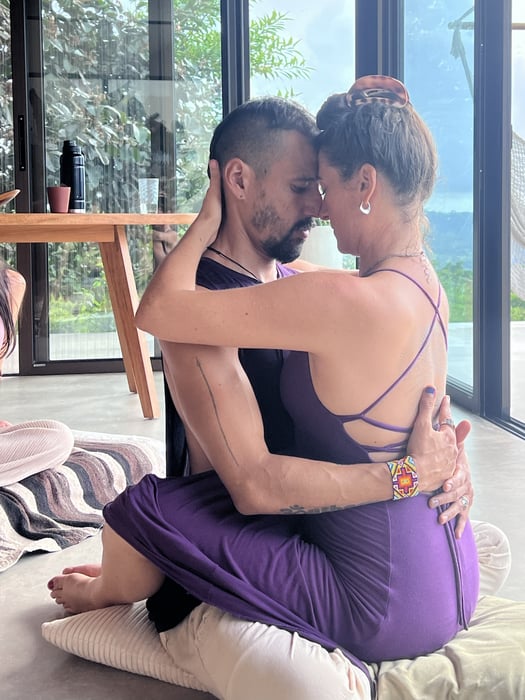
Instead of talking about your experience, you learn to feel it, track it, and gently move through it. It’s a bottom-up approach — starting in the body and reaching the mind — rather than the top-down route most of us were handed.
In practice, somatic bodywork for vaginismus can draw on a range of techniques, including:
- Somatic Experiencing® — a gentle method that helps the nervous system process and release stored stress or trauma, without having to relive it or talk through it in detail
- Titration and pendulation — moving slowly between uncomfortable sensations and safe ones, so the body learns it can handle difficulty without shutting down
- Holotropic breathwork — a guided breathing practice that can help release deep physical and emotional tension held in the body
- TRE® (tension and trauma releasing exercises) — simple exercises that trigger the body’s natural tremoring reflex, which helps discharge built-up stress from the muscles
- Myofascial release — gentle, sustained pressure on the connective tissue around the pelvis to release tightness and restriction
- Vaginal dearmouring — direct, consensual internal work on the pelvic floor muscles to release trigger points and chronic tension
- Dance and movement therapy — using guided movement to help the body find a new baseline of ease and safety, rather than bracing
When we work with the nervous system — making safety the priority and gently walking the body there — penetration stops being a test you’re failing and becomes something your body can genuinely say yes to.
This is the missing piece. Not instead of the emotional and erotic work — right alongside it.
Book a session with katrinwithlove
Inspired by my own journey past vaginismus, I now find joy in helping you claim your…
What somatic bodywork looks like when it works
One woman I worked with, N., had tried everything before we met — years of traditional therapy, then pelvic floor physiotherapy that, in her own words, only deepened the cycle of pain and pushed her further into dissociation.
It wasn’t until she added a body-based, emotionally attuned approach that her muscles began releasing naturally, with no dread and no force. She described penetration transforming from impossible to extremely pleasurable — and dilating becoming, of all unlikely things, a form of self-care.
Another woman, Brooke, came to understand that there is deep meaning and purpose in the symptoms we experience. Her body wasn’t broken. It was communicating. Once she learned to listen, everything softened.
These aren’t miracles. They’re what becomes possible when you finally meet the body.
Where to begin with somatic bodywork for vaginismus
You are not broken, and you do not have to think harder. You have to feel safer — in your body, on your body’s terms.
A skilled somatic practitioner can guide you there far faster than you’ll get there alone, especially one who understands the terrain of vaginismus.
If somatic bodywork for vaginismus feels like the right next step, Sensuali is a good place to find the right person to work with. Sensuali is a wellness platform connecting people with verified practitioners who specialise in body-based and intimacy-centred work — including somatic sex therapy, nervous system support, and pelvic trauma.
Every practitioner on the platform is verified, and sessions can be booked online or in person depending on what works for you. You can browse practitioner profiles, read about their approach, and reach out directly before committing to anything. It’s a low-pressure way to find someone who understands this terrain.
Your body has been protecting you this whole time.
Somatic bodywork is simply how you show it, at last, that the danger has passed.
Explore somatic practitioners
Trusted body-based support All practitionersJoin Katrin’s online support group: Sexually Liberated Membership For Vaginismus Sisters