What you'll know after reading this
- Relationship anarchy challenges traditional relationship hierarchies, encouraging people to define their connections on their own terms.
- Relationship anarchy and polyamory can overlap, but RA focuses on relationship freedom rather than the number of partners.
- Jealousy and insecurity can still arise in RA, making open communication and self-reflection important.

Relationship anarchy isn't about avoiding commitment or having multiple partners. It's about questioning traditional relationship rules and choosing what works for the people involved. Relational bodyworker and somatic sexologist Emma Alwyn explores how RA differs from polyamory, and the role of autonomy, communication and difficult emotions like jealousy.
If you have spent any time looking into non-traditional dating styles, you have probably run across the phrase relationship anarchy. But when we strip away the subculture buzzwords, what does it actually mean?
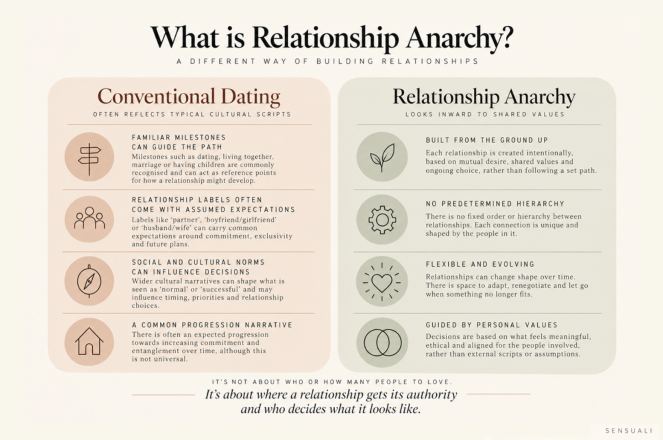
By rejecting the traditional “relationship escalator,” it directly challenges the gender roles and societal scripts that still dominate modern romance.
I’m Emma Alwyn, a queer relationship anarchist and student practitioner in relational bodywork and somatic sexology. I spend my time exploring how our life experiences shape the way we inhabit intimacy, boundaries, and personal freedom. Specifically, I look at what happens when our very human desire for close, varied connection bumps up against our equally human fear of losing the people we love.
The core shift here is about where a relationship gets its authority. In conventional dating setups, we often look outward to social milestones to tell us how to behave and how ‘well’ things are going. Relationship anarchy suggests that the people inside the dynamic look inward instead, letting their own values guide how they craft their commitments. It is a philosophy that doesn’t tell you who to love or how many people to love; instead, it asks you to decide your own framework intentionally.
You’re reading Sensuali
A space for exploring intimacy, sensuality and kink. Message trusted practitioners, book real experiences, discover sensual events and get answers in our forums.
What is relationship anarchy?
The term was popularised in 2006 by Swedish activist Andie Nordgren in a short manifesto that suggested something radical: the core principles of political anarchy, including self-governance, voluntary association, and the rejection of arbitrary power structures, could be applied directly to our personal lives. Nordgren wanted to offer an alternative to the rigid social scripts that often dictate how we are ‘allowed’ to care for one another.
Relationship anarchy questions the idea that love is a scarce resource that needs to be rationed, guarded, or reserved for one particular kind of relationship.
What if love doesn’t work like that? What if our capacity for love can expand through loving, if opening ourselves to other meaningful connections doesn’t necessarily diminish the love already present, but gives us more opportunities to experience it?
RA doesn’t prescribe what we should do with that possibility. Instead, it asks us to examine the assumptions we have inherited about who we can love, how we can love them, and what those connections are ‘allowed’ to become.
It is important to clarify that relationship anarchy isn’t a structured dating model, a trendy lifestyle brand, or a rigid checklist. By its very definition, it cannot be. It is an ongoing, reflective practice of deconstruction. It encourages deep reflection on your network of friends, lovers, family, and community, and organises those bonds based on what actually works for the real people involved, rather than according to external or societal expectations.
How does relationship anarchy work in practice?
In day-to-day life, relationship anarchy works much like a blank canvas. While dominant relationship scripts often provide a set menu of options, people practising relationship anarchy use tools like the “relationship anarchy smorgasbord”.
Think of it as taking a relationship apart into all its possible ingredients: cohabitation, sex, emotional support, shared finances, co-parenting, public recognition, and asking, which of these actually belong in this relationship?
Instead of assuming that romance automatically means moving in together, or that sexual intimacy requires shared bank accounts, people practising RA select only the elements that both people genuinely desire. This means a platonic friendship could involve co-parenting and buying a house, while a deeply loving romantic connection might involve living apart and maintaining entirely separate financial lives.
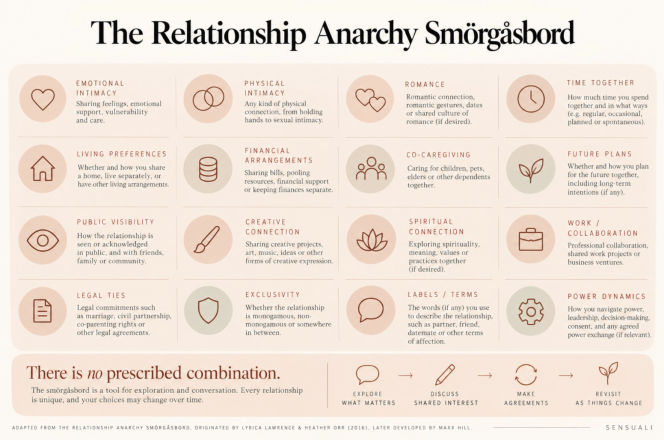
Because there is no default social script to rely on, this way of relating can involve a lot of real-time communication. You cannot fall back on unstated assumptions. Boundaries are discussed openly, and agreements are continually revisited and reshaped to fit the current energy, time, and emotional capacity of everyone involved.
How does RA differ from polyamory and CNM?
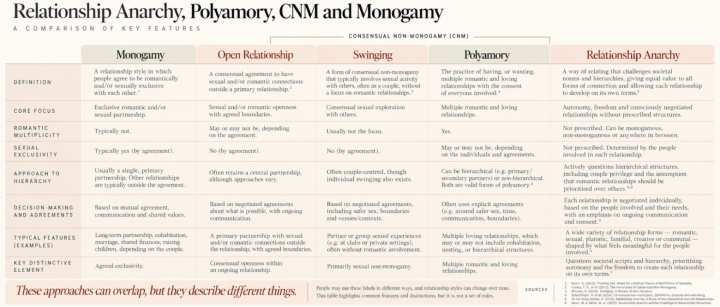
Because relationship anarchy involves the freedom to form multiple connections, it often gets mixed up with polyamory or broader consensual non-monogamy (CNM). While these approaches can overlap, they describe different things.
Polyamory is generally defined as the practice of having, or wanting, multiple romantic and loving relationships with the consent of everyone involved. Polyamorous relationships can take many forms. Some use explicit hierarchies, distinguishing between “primary” partners, such as a spouse or live-in partner, and “secondary” connections. Others deliberately reject hierarchy or organise relationships without primary and secondary categories.
Polyamorous relationships may include nesting arrangements (partners who live together), explicit agreements about boundaries and expectations, or, in some cases, veto powers (where one partner can ask another to end a relationship). However, none of these features defines polyamory itself.
Relationship anarchy is less about the number of relationships a person has and more about questioning the assumptions and power structures through which relationships are organised.
RA actively questions couple privilege and the assumption that romantic relationships should automatically outrank other forms of connection. Polyamory and relationship anarchy can overlap, but neither automatically implies the other.
For me, this distinction matters. What draws me to RA isn’t just the possibility of having more relationships; it’s the invitation to become more conscious of how I construct them.
Why do people choose relationship anarchy?
People rarely choose relationship anarchy by accident; they usually turn to it as a deliberate act of reclamation. The reasons people find themselves drawn to this perspective often stem from three basic desires:
- Autonomy: Traditional relationship structures can sometimes blur the line between commitment and control, treating partners as extensions of oneself. Relationship anarchy treats personal sovereignty as a baseline requirement. You keep full ownership of your body, time, and life choices, spending time with others through ongoing choice rather than because a relationship label says you should.
- Freedom from entitlement: When we inherit standard relationship scripts, an unstated sense of entitlement can sometimes develop. People can begin to feel entitled to their partner’s time, attention, or social circles because of a label. RA encourages these assumptions to be made visible and agreements to be consciously discussed and willingly chosen. This shifts the dynamic from assumed duty towards active choice.
- An expansive view of care: We are often taught that intimacy is a scarce resource that must be carefully rationed and saved for one person. Relationship anarchy is built on the belief that human connection is expansive. Letting a close connection grow deep and important doesn’t take away from a romantic partnership; it can expand and strengthen your wider network of care.
Ultimately, people choose this path because it lets relationships function as dynamic, evolving connections. It gives relationships the space to grow, shift, or scale back naturally over time without those changes being labelled a failure.
Explore relationship anarchy with a relationship coach
On Sensuali
Explore coaches-
Bash92 ENM Portland
-
alicelovegood ENM Berlin
-
jarla ENM coaching Berlin
-
RavenLove Couples coaching Santa Barbara
-
elody-ecstasy Couples coaching Los Angeles
-
anchal-kaushal Couples coaching Goa Velha
-
greydoolin Couples coaching Boston · Cincinnati
-
greta-flowers Couples coaching Seattle
-
laura-elizabeth Couples coaching Perth
-
mother-scarlet Couples coaching Amsterdam
-
sophia-rose Couples coaching London
-
priestess-aria Open relationship Austin
-
emma-ania Open relationship Vienna
-
rentyaw Open relationship Lincoln · Gainesville · New York
-
sara-grace Open relationship New York
-
-
nic-queerly Open relationship Jaworze
-
tisabelrvelasquez Open relationship Bologna
-
thisisemmaalwyn Open relationship Carmarthen · Bristol
-
NataliesQueendom Relationship guide Ko Pha-ngan
Navigating the emotional side of relationship anarchy
Stepping away from conventional relationship scripts sounds incredibly liberating in theory, but in practice, it can take a lot of emotional resilience. When we begin questioning familiar relationship structures and expectations, we can find ourselves face-to-face with our own insecurities, fears, and early attachment patterns.
Some relationship scripts encourage us to seek security through certainty about another person’s behaviour. Relationship anarchy invites a different question: what happens if, alongside negotiating agreements with others, we also become curious about what an uncomfortable emotion is communicating within us?
Jealousy, for example, isn’t treated as something to repress or use as a weapon; it can be looked at as a physical, somatic piece of information. In my relational bodywork practice, I see jealousy show up in very literal, physical ways: a tightening across the chest, a hollow feeling in the stomach, or a sudden flash of heat.
Instead of reacting to these raw physical sensations by lashing out or trying to control someone else, we can look at them with genuine curiosity. What is the body actually trying to say? Sometimes jealousy leads towards fears of abandonment, a longing for reassurance, unmet needs, or earlier relational experiences. At other times, it may be telling us something important about the relationship in front of us.
Somatic exploration isn’t about deciding in advance what jealousy means. It’s about getting curious about how it lives in the body, and what might be underneath it.
Need someone to guide the conversation?
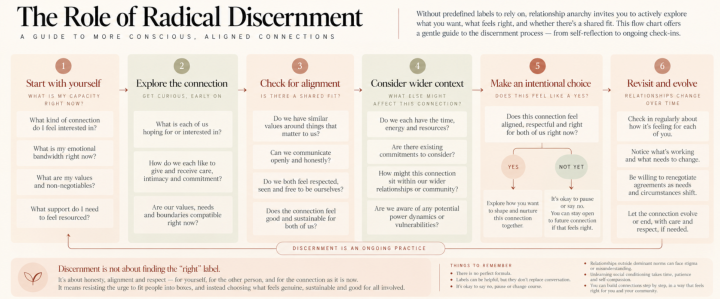
The role of radical discernment
An important part of relationship anarchy is learning to make conscious choices about the people you connect with, rather than simply following familiar relationship patterns. This is where radical discernment comes in. When you don’t have standard relationship labels doing the heavy lifting for you, you can’t just assume you and another person mean the same thing when you talk about commitment. You have to actively evaluate compatibility, emotional bandwidth, and capacity for the kind of relationship you’re creating together.
Discernment means being completely honest with yourself about your own capacity, and choosing connections based on shared values and mutual respect above a desire to feel chosen. It means resisting the urge to fit people into boxes (even though this can feel so convenient at times), choosing instead to be present with the connection exactly as it exists in the moment.
Operating this way in a culture that values clear, easily categorised boxes takes a lot of vulnerability. People whose relationships fall outside dominant norms may encounter stigma, misunderstanding, or a lack of social recognition. Unlearning years of social conditioning is a slow, daily practice rather than a quick fix. It requires a lot of patience, self-compassion, and a willingness to figure out what is genuinely right for you and your community, step by step.
Relationship anarchy as a wider philosophy
The most common misunderstanding about relationship anarchy is that it is just a sophisticated excuse to sleep around without any consequences or commitments. This is the trap of what is sometimes jokingly called “polyfuckery”, a consumerist, superficial misreading of a much deeper philosophy.
RA is not a hall pass to avoid accountability or skip the hard work of building intimacy. Without an unwritten rulebook to fall back on, communication and accountability become part of the practice itself.
Crucially, relationship anarchy is not defined by the number of partners you have, nor does it mean a relationship must be sexually open. Because RA intentionally moves past the strict binary of monogamy versus non-monogamy, it removes sex as the primary organiser of human life. An RA practitioner can absolutely choose to have a sexually exclusive arrangement with a partner. The defining characteristic isn’t whether you have other lovers; it is that the connection is built on ongoing choice and individual sovereignty, rather than couples-privilege or social expectation.
For me, at its root, relationship anarchy is a broader socio-political philosophy about how we share power, care, and intimacy in a highly individualistic world.
It challenges the notion that human relationships are consumer goods to be collected, ranked, or discarded the moment they become inconvenient or no longer fit the shape we expected them to.
Final thoughts
By taking away the pressure to reach a specific, predetermined outcome, relationship anarchy gives connections the room to change and transition naturally. Within dominant relationship scripts, if a romantic partnership stops including sex, or if a cohabiting couple decides they need their own living spaces, these changes can sometimes be interpreted as signs that the relationship is failing. Relationship anarchy creates space for those changes to be understood as an evolution rather than automatically interpreted as failure.
It allows a relationship to shift from a romantic partnership into a reliable, platonic anchor without assuming that love or mutual respect must disappear with it. It acknowledges that human beings are changing ecosystems, and our relationships need the space to change right along with us.
Book couples experiences on Sensuali
With trusted practitioners
Couples experiences-
From €30
-
From £29
-
From €120
-
From $1000
In person, Sebastopol, US
In-person private couples' retreat focused on revitalizing sexual energy
By Wholly Erotic -
From £120
-
From £130
-
From $350
Related reading
Opening up: a guide to ethical non-monogamy for couples
Finding an ENM therapist or coach: what to look for
Love without a rulebook: meet relational somatic sexologist Emma Alwyn
Master Reference List
- Barker, M., Heckert, J., & Wilkinson, E. (2013). Polyamorous Intimacies: From One Love to Many Loves and Back Again. Open Research Online.
- Brake, E. (2012). Minimizing Marriage: Marriage, Morality, and the Law. Oxford University Press.
- DePaulo, B. (2006). Singled Out: How Singles Are Stereotyped, Stigmatized, and Ignored, and Still Live Happily Ever After. St. Martin’s Press.
- Ferrer, J. N. (2018). Beyond the non/monogamy system: fluidity, hybridity, and transcendence in intimate relationships. Psychology & Sexuality, 9(1), 3–20.
- Meyer, I. H. (2003). Prejudice, social stress, and mental health in lesbian, gay, and bisexual populations: Conceptual issues and research evidence. Psychological Bulletin.
- Moen, O. M., & Sørlie, A. (2022). The Ethics of Relationship Anarchy. The Anarchist Library.
- Nordgren, A. (2006). The Short Instructional Manifesto for Relationship Anarchy. Interacting Arts.
- Schudson, Z. C., & van Anders, S. M. (2019). You can’t put a number on intimacy: Expanding frameworks for consensual non-monogamy and relationship anarchy. Psychology of Sexual Orientation and Gender Diversity.
- The Thinking Aro. (2016). Relationship Anarchy is not About Sex or Polyamory. The Anarchist Library.
Sources & further reading.
- Nordgren, Andie (2006), Interacting Arts.. The Short Instructional Manifesto for Relationship Anarchy.
- De las Heras Gómez, Roma (2019). Sociological Research Online, 24(4), 644–660. SAGE Publications.. Thinking Relationship Anarchy from a Queer Feminist Approach.
- Moen, Ole Martin & Sørlie, Aleksander (2022). In The Routledge Handbook of Philosophy of Sex and Sexuality. Routledge.. The Ethics of Relationship Anarchy.
- Ferrer, Jorge N. (2018). Psychology & Sexuality, 9(1), 3–20. Taylor & Francis.. Beyond the non/monogamy system: fluidity, hybridity, and transcendence in intimate relationships.
- Psychology & Sexuality, 9(1), 3–20. Taylor & Francis. Meyer, Ilan H. (2003).. Prejudice, social stress, and mental health in lesbian, gay, and bisexual populations: Conceptual issues and research evidence.

Emma Alwyn
Emma Alwyn is a queer Relational Somatic Sexologist in training who works with individuals, couples and relationship ecosystems, exploring intimacy, desire, sex, relationships and belonging. Living in community on a permaculture farm in Wales, she also leads conscious dance journeys that invite people into a deeper…
More from Emma Alwyn